SQL Clone operates by attaching databases; when you are attaching a database to a new server, this may expose you to a common issue with SQL Server logins and their internal references on the SQL Server you are delivering a database to.
I have 2 SQL Servers; RM-IClone1 and RM-IClone2. In each I create a SQL Server login and map it to a user in my Forex database.
On each server, I run the following to create a SQL Server Login and matching user in the Forex database
USE [master] GO CREATE LOGIN [OneSQLServerUser] WITH PASSWORD=N'MyC0mpliantPa$$word', DEFAULT_DATABASE=[master], CHECK_EXPIRATION=OFF, CHECK_POLICY=OFF GO USE [Forex] GO CREATE USER [OneSQLServerUser] FOR LOGIN [OneSQLServerUser] GO ALTER ROLE [db_owner] ADD MEMBER [OneSQLServerUser] GO |
I then create a SQL Clone Image from the Forex database on RM-IClone1, and deliver it as a clone database to RM-IClone2.
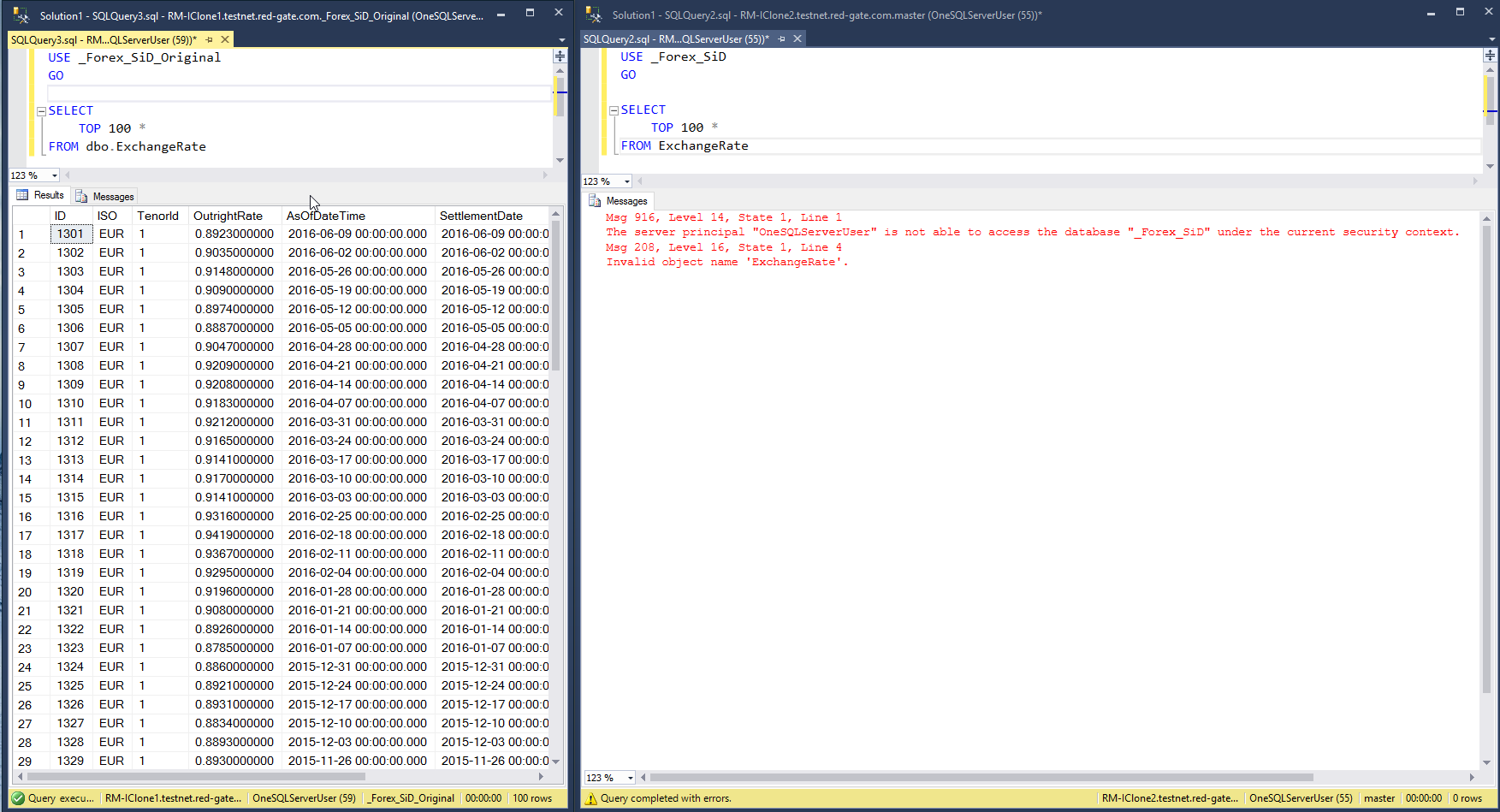
Running an identical query on the original Forex database and on its clone database I see the following;
The solution is to recreate the login on the target SQL Server, but with a matching SID to the source server.
First, obtain the SID that is to be used:
-- On the source SQL Server from which the SQL Clone image was created USE Forex GO SELECT name, sid, principal_id FROM sys.database_principals WHERE Name = 'OneSQLServerUser' |
Next, on the server you have delivered the clone database to, run the following to recreate the login and remap the user account:
-- On the target SQL Server to which a clone database has been delivered USE master go DROP LOGIN OneSQLServerUser; GO CREATE LOGIN OneSQLServerUser WITH PASSWORD = 'MyC0mpliantPa$$word', SID = 0x3D195F3CF7D2D443974CBAF65BF7E479; GO USE _Forex_SiD GO ALTER USER OneSQLServerUser WITH Login = OneSQLServerUser; |
Full details are in this MSDN article - https://msdn.microsoft.com/en-GB/library/ms175475.aspx