
These pages cover SQL Clone Beta 0.6 to 0.9, which is not the latest version. Help for other versions is also available.

Fully removing an old version
If you have installed any previous version of SQL Clone, you can ensure it's fully removed by:
- Removing all clones within the application, and deleting the folder "localappdata%\Red Gate\SQL Clone\clones"
- Removing all images within the application, and deleting any files left on disk
- Uninstalling the old version
- Rebooting the machine
- Ensuring that there are no services called "Redgate SQL Clone" or "Redgate SQL Clone Agent"
Getting set up
The majority of SQL Clone installation issues occur because the OS does not have the latest updates.
Install the latest OS updates, and check the requirements and limitations pages to ensure your system is compatible before proceeding.
Error 1923. Service 'Redgate SQL Clone Agent' (Redgate SQL Clone Agent) could not be installed. Verify that you have sufficient privileges to install system services.
This can also mean a service with that name already exists. Ensure any previous SQL Clone installations are removed, and try again.
Could not execute "...VCRedist2015": Installation error 1 when running
Ensure your system is 64-bit, there are no plans to support 32-bit operating systems.
Problems during configuration wizard
This usually happens when the installed service cannot start. Check the Application section of the Windows Event Viewer for extra information.
Where is SQL Clone?
SQL Clone serves a web app accessible in your browser at: http://machinename:14145
Someone in your organization should be able to tell you the relevant machine name where the SQL Clone Server is installed.
SQL Clone Agent installation
"An existing connection was forcibly closed by the remote host" error during SQL Clone Agent installation
When the SQL Clone Agent installation fails, you might see an error among Windows Application Event Logs, which is similar to below one:
System.Net.Http.HttpRequestException: An error occurred while sending the request. ---> System.Net.WebException: The underlying connection was closed: An unexpected error occurred on a send. ---> System.IO.IOException: Unable to read data from the transport connection: An existing connection was forcibly closed by the remote host. ---> System.Net.Sockets.SocketException: An existing connection was forcibly closed by the remote host
  at System.Net.Sockets.Socket.EndReceive(IAsyncResult asyncResult)
  at System.Net.Sockets.NetworkStream.EndRead(IAsyncResult asyncResult)
  --- End of inner exception stack trace ---
  at System.Net.TlsStream.EndWrite(IAsyncResult asyncResult)
  at System.Net.ConnectStream.WriteHeadersCallback(IAsyncResult ar)
  --- End of inner exception stack trace ---
  at System.Net.HttpWebRequest.EndGetRequestStream(IAsyncResult asyncResult, TransportContext& context)
  at System.Net.Http.HttpClientHandler.GetRequestStreamCallback(IAsyncResult ar)
  --- End of inner exception stack trace ---
  at System.Runtime.CompilerServices.TaskAwaiter.ThrowForNonSuccess(Task task)
  at System.Runtime.CompilerServices.TaskAwaiter.HandleNonSuccessAndDebuggerNotification(Task task)
  at RedGate.SqlClone.Agent.ManagementServiceClient.JsonHttpClient.<Post>d__5`2.MoveNext()
--- End of stack trace from previous location where exception was thrown ---
  at System.Runtime.CompilerServices.TaskAwaiter.ThrowForNonSuccess(Task task)
  at System.Runtime.CompilerServices.TaskAwaiter.HandleNonSuccessAndDebuggerNotification(Task task)
  at RedGate.SqlClone.Agent.ManagementServiceClient.RegistrationClient.<Register>d__2.MoveNext()
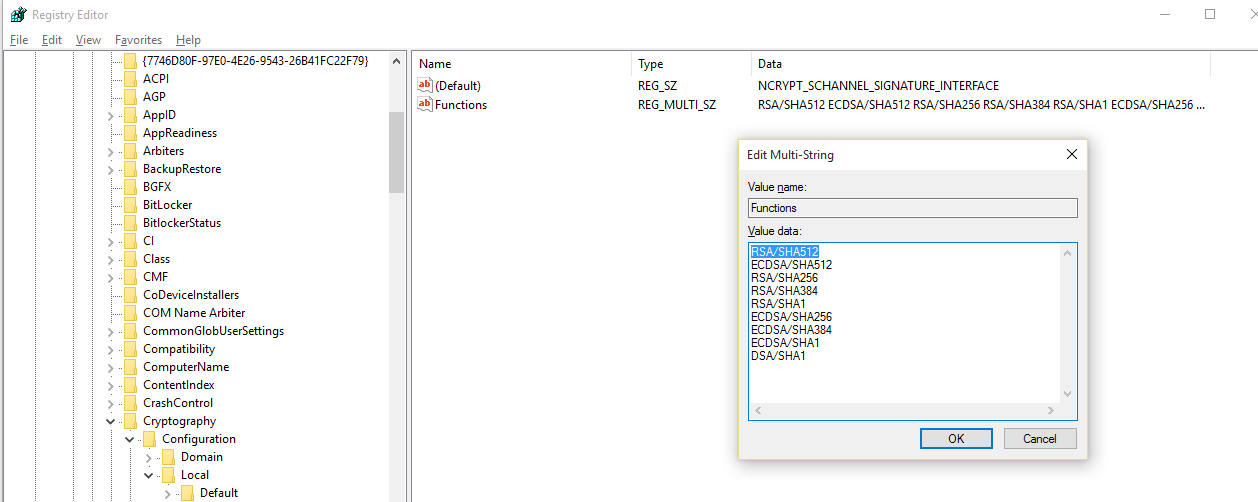
This error may occur when SHA512 is disabled in Windows when you use TLS 1.2 on the machine where you are trying to install the SQL Clone Agent on. You can check whether this is the case by looking at the "HKEY_LOCAL_MACHINE\SYSTEM\CurrentControlSet\Control\Cryptography\Configuration\Local\SSL\00010003" REG_MULTI_SZ registry value and see if you can see "RSA/SHA512" there like you do in below image:
- Uninstall SQL Clone Agent from the machine that you are having problems with
- Remove "SQL Clone Agent" certificate from local machine certificate store
- Upgrade the SQL Clone server to latest available release
- Download SQL Clone Agent from the SQL Clone Web UI and install it
"Could not load file or assembly 'RedGate.SqlClone.Unmanaged.dll' or one of its dependencies" error during SQL Clone Agent installation
When the SQL Clone Agent installation fails, you might see an error among Windows Application Event Logs, which is similar to below one:
System.IO.FileNotFoundException: Could not load file or assembly 'RedGate.SqlClone.Unmanaged.dll' or one of its dependencies. The specified module could not be found.
File name: 'RedGate.SqlClone.Unmanaged.dll'
at RedGate.SqlClone.Agent.Service.SqlCloneSetup.InitializeAgent()
at RedGate.SqlClone.Agent.Service.RegisteredAgentLifetime.CreateRegisteredAgentLifetime(AgentSettings settings, X509Certificate2 certificate, CancellationTokenSource cancellationTokenSource, ILogger logger, Boolean retryRegistration)
at RedGate.SqlClone.Agent.Service.AgentServiceTask.<>c__DisplayClass8_0.<RegisterAndStartAsync>b__0()
at System.Threading.Tasks.Task`1.InnerInvoke()
at System.Threading.Tasks.Task.Execute()
--- End of stack trace from previous location where exception was thrown ---
at System.Runtime.CompilerServices.TaskAwaiter.ThrowForNonSuccess(Task task)
at System.Runtime.CompilerServices.TaskAwaiter.HandleNonSuccessAndDebuggerNotification(Task task)
at RedGate.SqlClone.Agent.Service....
This can happen when Microsoft Visual C++ 2015 Redistributable (x64) is not installed correctly on the machine. SQL Clone Agent installer currently tries to install this dependency if it's not already there. However, the installation is not performed correctly when you do not have KB2919355 installed. KB2919355 also requires KB2919442 installed prior to installing it. In order to fix this issue, you need to follow the below steps in given order:
- Download the appropriate version of KB2919442 depending on your Windows version and install it.
- Download the appropriate version of KB2919355 depending on your Windows version and install it.
- Restart Windows.
- Download Microsoft Visual C++ 2015 Redistributable (x64) and install it.
- Retry the installation of SQL Clone Agent.
Creating an image
The requested operation could not be completed due to a file system limitation (Win32Exception)
Ensure the image destination you chose has more free space than the size of your database, and ensure the disk is defragmented.
If you are running on Windows 7/Windows Server 2008 R2, this problem can also occur when creating images to a network path which is on the same machine as the agent creating the image. This should be fixed in a subsequent release. A workaround at the moment is to use a network location which is on a different machine. You can also specify a local path, but this will prevent you from sharing images to other machines successfully.
I can see failed images on Web UI and I cannot delete them
Unfortunately, we don't currently have a way to clear out the failed items on the Web UI. However, we are aware of this restrictions and it's on our backlog to get it done. As a workaround, you can run the below update command against our config database. it will mark those failed images as deleted. Please make sure that the database name reflects the database name that you configured it to. It's "SQLClone_Config" by default.
UPDATE [SQLClone_Config].[dbo].[Images] SET [State] = 4, DeletedOn = GETUTCDATE()
WHERE [State] = 6 AND DeletedOn IS NULL;
"The operating system returned error 21(The device is not ready.) ..."
This occurs when the network link between the clone and the image is broken. Unfortunately SQL Server tends to cache the error message. On newer versions of SQL Server, cycling the database offline and online usually fixes the problem - SQL Clone periodically monitors for this condition and attempts the fix if necessary. Restarting the SQL Server process should always fix this issue.